A thank-you page

Andrew's Birthday Rocks
from the team

You gave me four rocks. I did what I do with rocks: photographed each one on a turntable, built a 3D model, put it under the UV lamps, and read up on where each one comes from. Here's the tour.

Rock 1 of 4

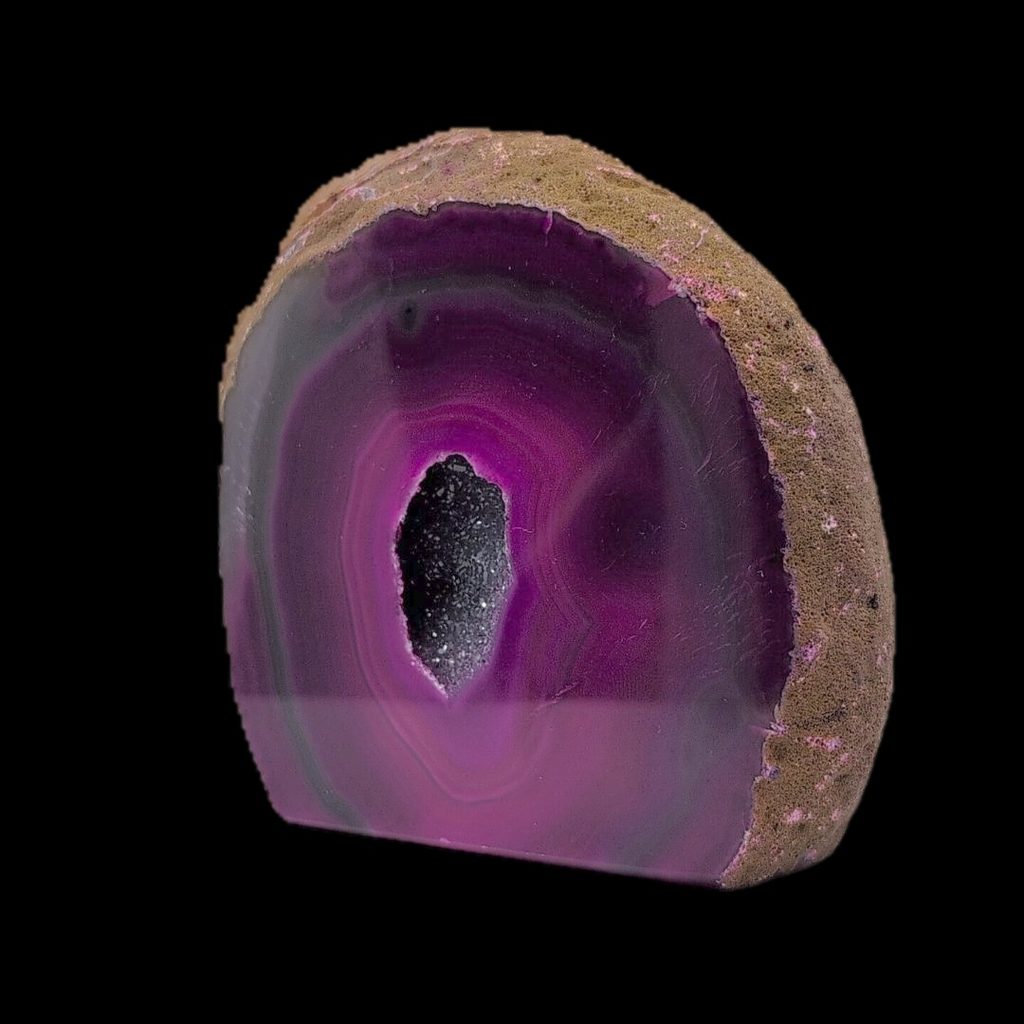
The Pink Geode

A polished agate geode end, dyed hot pink, with a sparkling quartz cave in the middle

MineralAgate, with a quartz crystal cave
Size3.5 × 3.5 × 1.3 in (9 × 9 × 3.4 cm)about the size of a coffee mug across
Weight1.2 lb (544.9 g)about as heavy as a can of soup
Where it's fromCut and coloured in Brazil; the agate itself most likely from Rio Grande do Sul, southern Brazil

Agate is a form of quartz that grows ring by ring inside a gas bubble in old lava. Cut one open and you get this: concentric rings around a hollow, and the hollow lined with tiny quartz crystals that catch the light.

The hot pink is a dye, the classic finish for decorative Brazilian agate, and it is a big part of the look. The colour sits deepest in the sparkly cave and the rough outer skin, and under a UV lamp the pink bands glow a bright orange, which makes for a good party trick.

The sticker underneath says Made in Brazil, which is where it was sawn, polished and coloured. The agate itself almost certainly came out of the old lava country of Rio Grande do Sul in southern Brazil, where most of the world's agate is dug.
Spin it

Drag left or right. Standing up, the way it sits on a shelf.

The Pink Geode, turning
drag to turn

Hold it

A 3D model built from the turntable photos. Drag to orbit, pinch to zoom.

Three things to know

  1. Agate takes dye well because it is ever so slightly porous, and pale agate has been tinted for the decorative trade for a couple of centuries.
  2. Inside a geode the quartz crystals grow from the walls toward the middle, every point aimed at the hollow.
  3. The lava that this agate formed in flowed across southern Brazil and Uruguay around 135 million years ago.
Rock 2 of 4

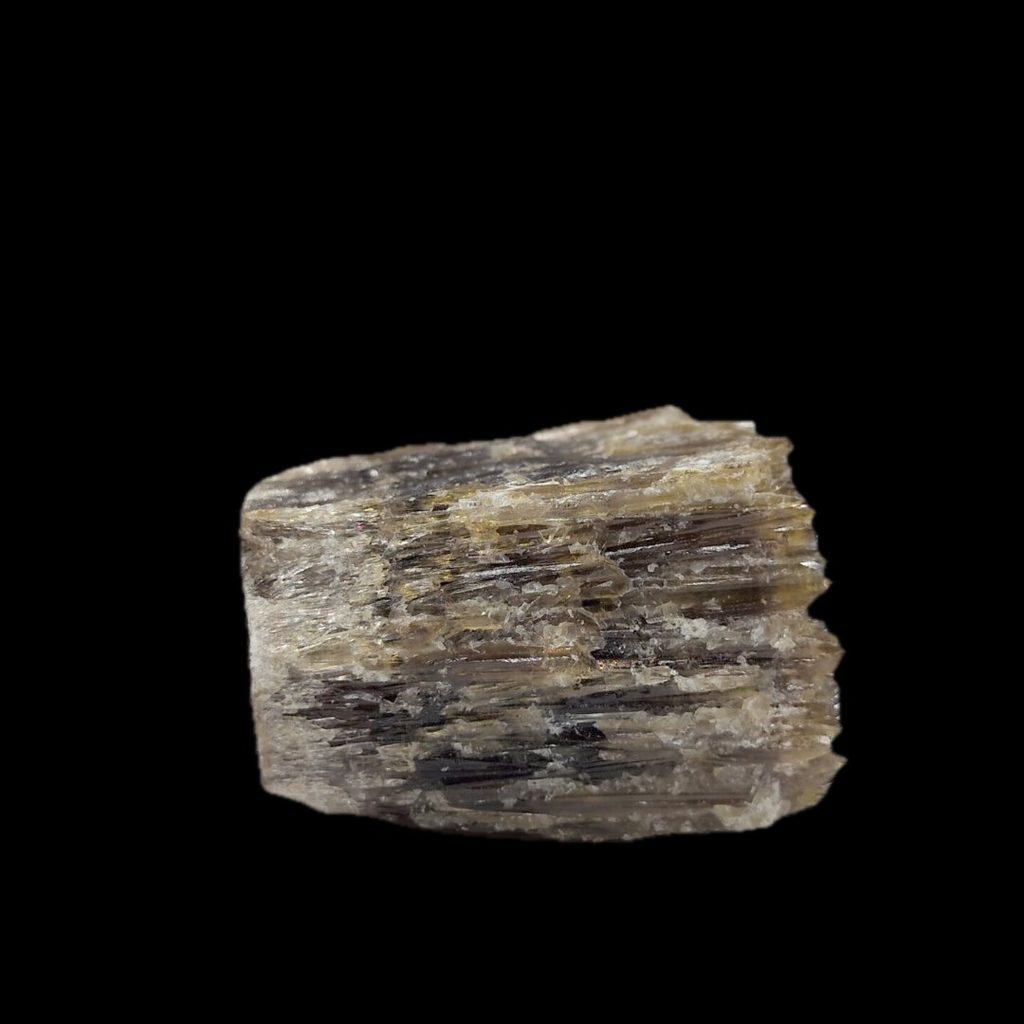
The Honey Block

A block of honey-gold quartz crystals from the wall of a geode

MineralQuartz
Size2.3 × 2.1 × 1.4 in (5.9 × 5.4 × 3.5 cm)about the size of a golf ball and a half
Weight5 oz (151.4 g)about as heavy as a baseball
Where it's fromThe amethyst geode country of southern Brazil and northern Uruguay, where honey quartz like this comes from

Look at it from the side and you see the structure: closely packed quartz columns rising from a milky white base and ending in a crust of small, sharp points. That is a slice of geode lining, the crystal wall that grew inward from the rock.

The honey colour has a story. Quartz this colour, growing from white roots, is usually amethyst that was gently heated: heat turns amethyst's purple to yellow and brown, and the result goes by the name citrine. It may also be natural smoky quartz. Either way it is the same mineral, and the colour runs right through the crystals.

The six-sided points are classic quartz, each one a tiny pyramid with flat glassy faces, and the best of them sit right at the top of the crust where the light catches them.

Spin it

Drag left or right. Lying on its side, so you see the points and the base.

The Honey Block, turning
drag to turn

Hold it

A 3D model built from the turntable photos. Drag to orbit, pinch to zoom.

Three things to know

  1. Heat is how most golden citrine is made: warm amethyst past a couple of hundred degrees and its purple turns to gold.
  2. Quartz is the yardstick for hardness. It defines 7 on the 10-point scale, so a steel knife will not scratch it.
  3. Most of the world’s citrine, natural or heated, comes from Brazil.
Rock 3 of 4

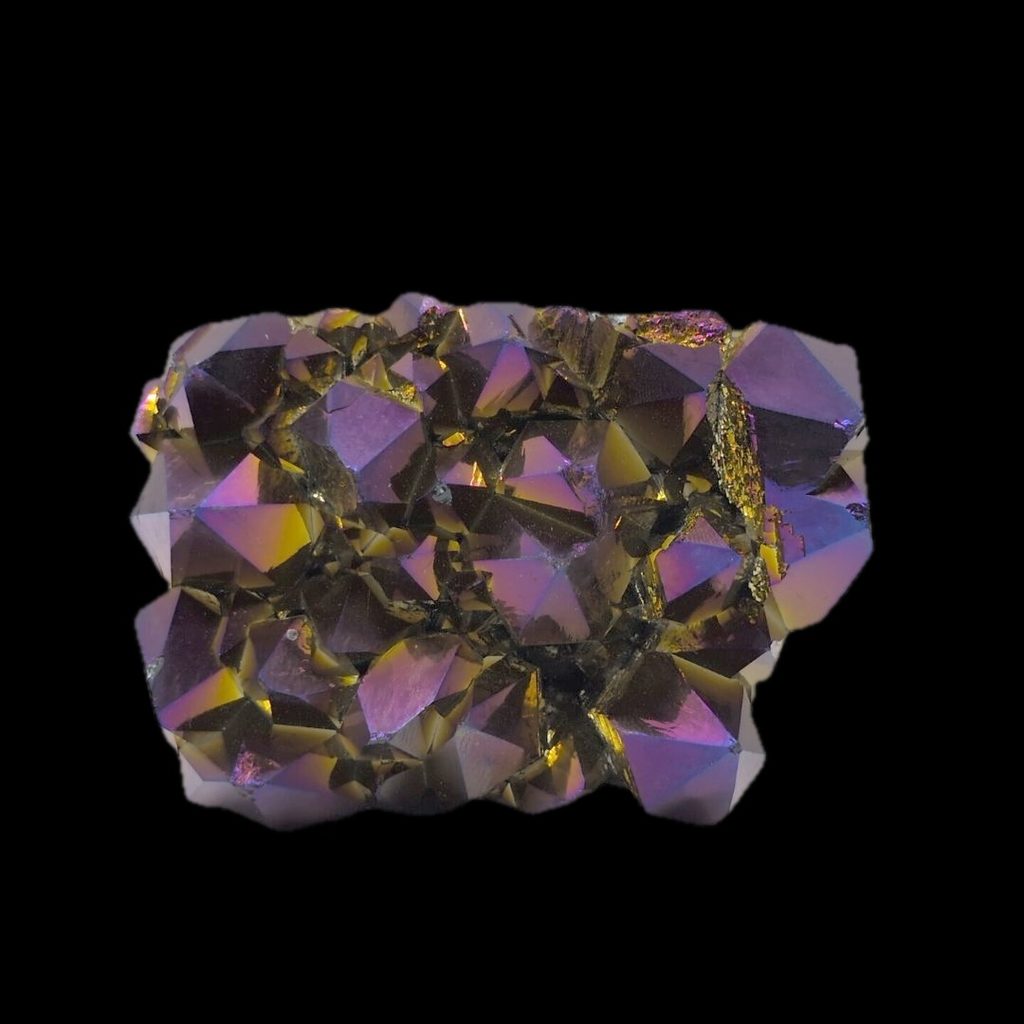
The Peacock Cluster

A quartz crystal cluster finished with a titanium film that shimmers gold and violet

MineralQuartz, with a titanium shimmer coat
Size2.8 × 2.0 × 1.6 in (7 × 5.2 × 4 cm)about the size of a tennis ball
Weight6 oz (182 g)about as heavy as a smartphone
Where it's fromBrazilian geode country, most likely, with the finish added in a workshop

The crystals are stubby quartz, the kind that lines a geode, and the shimmer is a metal finish: the cluster goes into a vacuum chamber, metal vapour (usually titanium) settles onto every surface, and the film is so thin that it splits light into colours, the same trick as oil on a puddle. Gold on the flat side faces, violet and magenta on the tips, depending on the angle.

This finish goes by “titanium aura” or “flame aura.” Turn it over and the flat base is bare grey quartz, because the cluster lay face up in the chamber while the film settled.

Under a UV lamp it turns into a tiny mirror, which is exactly what a metal film should do.

Spin it

Drag left or right. Lying face up and turning; you get a glimpse of the bare base.

The Peacock Cluster, turning
drag to turn

Hold it

A 3D model built from the turntable photos. Drag to orbit, pinch to zoom.

Three things to know

  1. Quartz keeps time: a sliver of it vibrates at a perfectly steady rate when given a tiny electric nudge, which is the quartz in a quartz watch.
  2. The shimmer coat works like oil on water: a film so thin that light splits into colours as it bounces off.
  3. After feldspar, there is more quartz in the Earth’s crust than any other mineral.
Rock 4 of 4

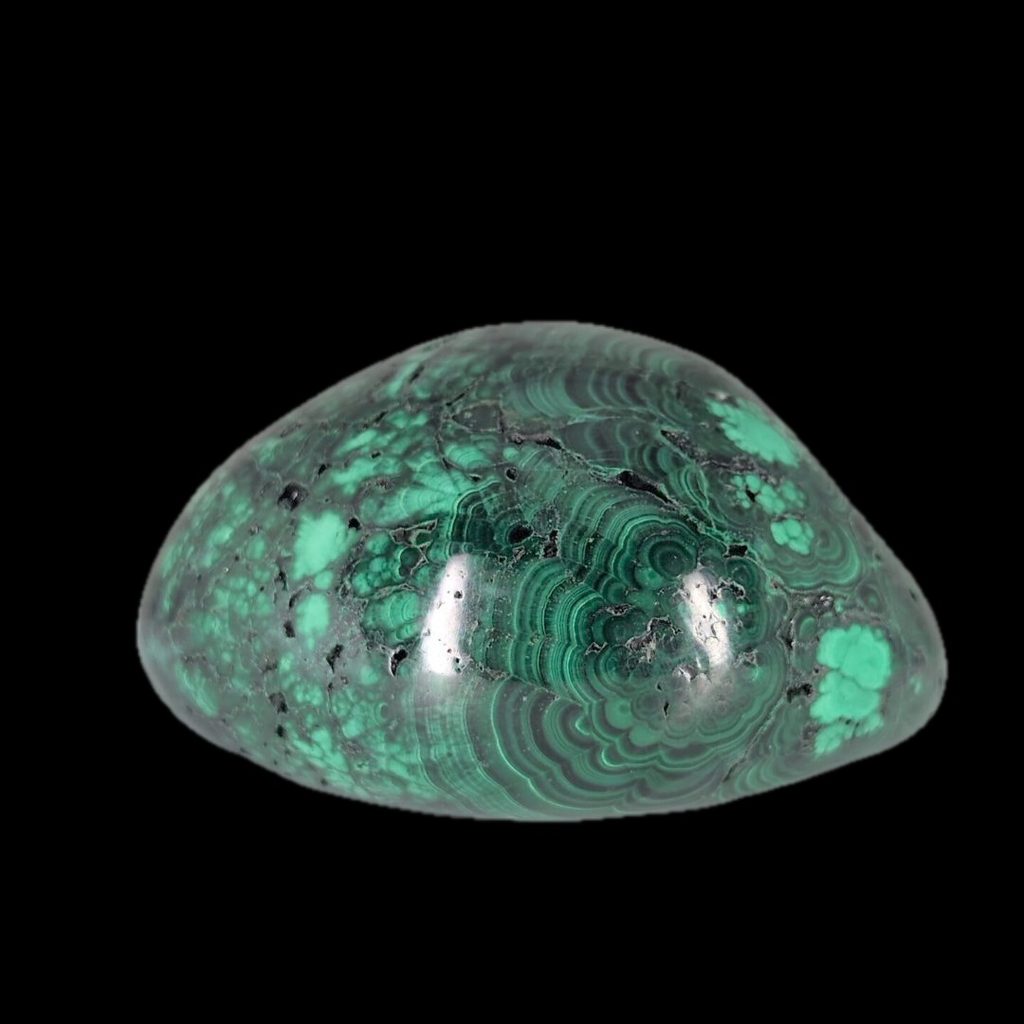
The Green Marble

Polished malachite from the Congo's copper country

MineralMalachite
Size3.0 × 2.8 × 1.8 in (7.7 × 7.1 × 4.5 cm)about the size of a baseball
Weight16 oz (443.9 g)about as heavy as a football
Where it's fromKatanga Province, Democratic Republic of the Congo

Malachite is a copper mineral, and it grows where copper ore slowly weathers near the surface. It builds up in layers, which is why a polished piece shows rings, bull’s-eyes and rounded, knobbly sections: each ring is one more layer of green laid down over time.

This one was polished into a palm stone, and the pits and little open cavities came with it: they are where the layers grew around gaps, and the sparkle inside them is a lining of tiny crystals, the last ones to grow before the stone closed over. Polishers leave those alone, and they are the best part to catch in the light.

It came with a card naming Katanga Province in the Democratic Republic of the Congo. That is the Congolese side of the Copperbelt, and the mines around Kolwezi there supply much of the world’s malachite for polishing, so the card and the stone agree.

Spin it

Drag left or right. Lying flat and turning.

The Green Marble, turning
drag to turn

Hold it

A 3D model built from the turntable photos. Drag to orbit, pinch to zoom.

Three things to know

  1. Malachite is named after the mallow plant, whose leaves are the same green.
  2. Ground up, it was a green paint pigment from ancient Egypt until about 1800, and the Egyptians wore it as eye paint.
  3. The mines around Kolwezi in Katanga supply much of the world’s malachite for polishing, so this stone comes from the heart of malachite country.